Travel essentials / Before you fly
Can you use a power bank on a plane?
Carrying it, using it and recharging it are three different questions. Here’s what to check.
BY NEXT UP GUIDE · CHECKED SEPTEMBER 25, 2026
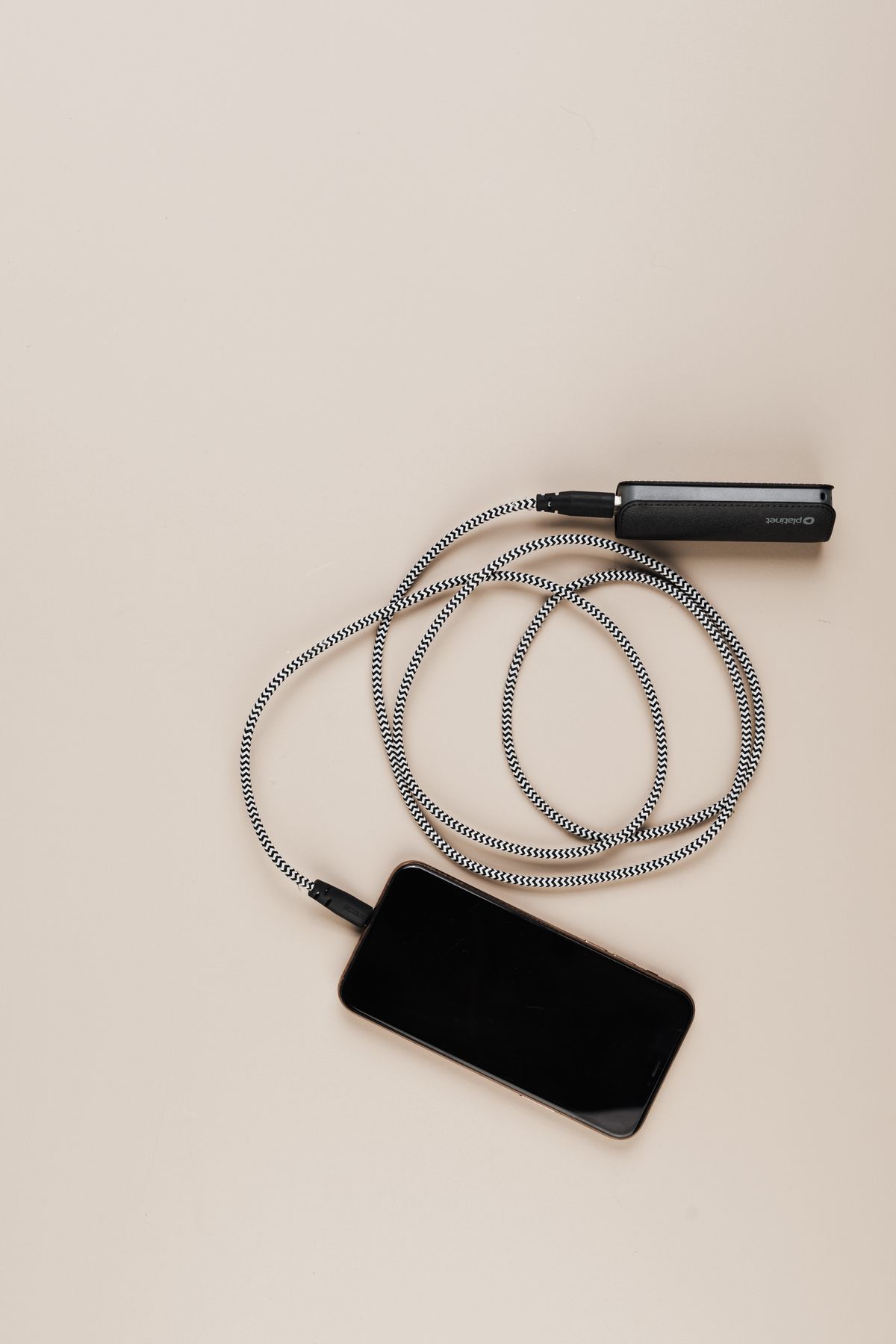
Sometimes—but being allowed to pack a power bank does not mean you can plug it in during the flight. Ryanair allows you to charge a device except during taxi, take-off and landing, or when the crew says otherwise. Singapore Airlines prohibits using one throughout the flight. Neither allows you to recharge the bank onboard. The comparison below covers nine airlines, with the conditions that matter before you pack.
Packing a power bank for a long flight? Check more than its capacity. Your airline may let you bring it into the cabin but require you to keep it unplugged until you land.
Jump to: Airline comparison · Capacity · Packing
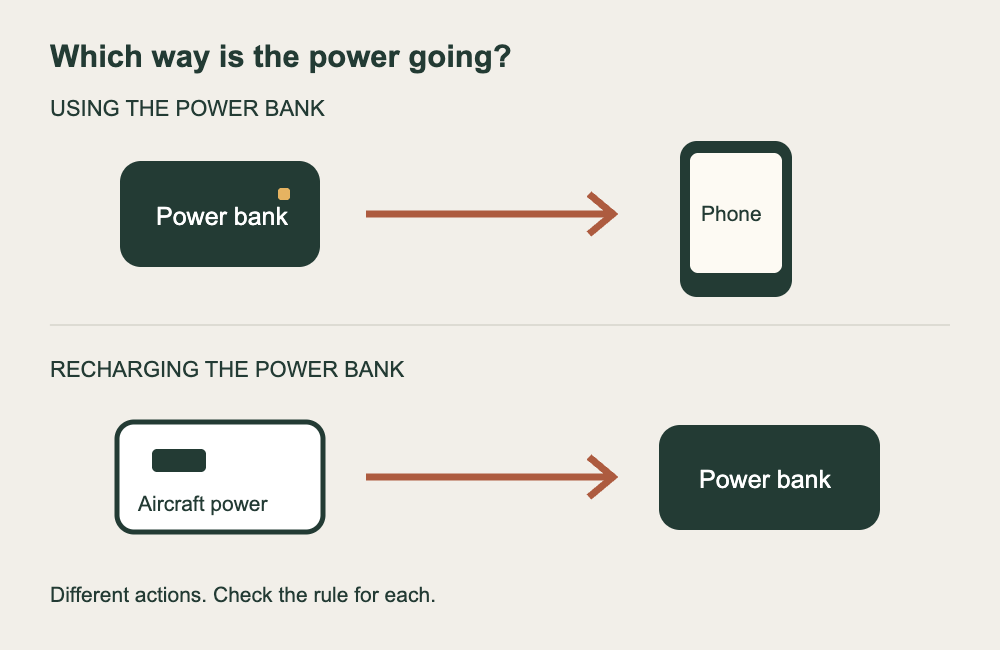
“Charging” can mean two different things
Using the bank: the bank supplies electricity to your phone, tablet or another device. Recharging the bank: electricity goes into the bank from a seat socket, USB port or another bank. A policy can treat these actions differently, so look for both—not just the word “allowed.”
Your power bank says mAh. What does that mean in Wh?
If you know your power bank as a “10,000mAh” or “20,000mAh” model, start here. These examples use a nominal battery voltage of 3.7V.
| Capacity in mAh | Energy in Wh |
|---|---|
| 10,000mAh | 37Wh |
| 20,000mAh | 74Wh |
| 30,000mAh | 111Wh |
A 20,000mAh bank at 3.7V is below 100Wh; a 30,000mAh bank at 3.7V is above it. These are conversion examples, not permission to fly. Use the Wh printed on your actual product first: a different nominal voltage changes the result. Then check your airline’s capacity, quantity and approval conditions below.
Power bank rules: nine airlines at a glance
Power bank → device means using your power bank to charge a phone, tablet or laptop during the flight. Recharge power bank means charging the power bank itself onboard. The maximum number is per passenger. Capacity limits apply to each power bank. ✓ Yes means subject to the stated conditions; × No means prohibited. “Conditional” is not unrestricted permission. This comparison covers ordinary personal power banks, not medical equipment or batteries built into smart luggage. Checked September 25, 2026.
| Airline / official rules | Carry in cabin | Max. per person | Capacity per bank | Power bank → device | Recharge power bank | Checked bag |
|---|---|---|---|---|---|---|
| Singapore Airlines ↗ | ✓ Yes | 2 | ≤100Wh; >100–160Wh requires approval | × No | × No | × No |
| Emirates ↗ | ✓ Yes | 1 | Advisory: ≤100Wh; exactly 100Wh: see note | × No | × No | × No |
| Qatar Airways ↗ | ✓ Yes | 2 | ≤100Wh | Conditional · non-critical phases, directly supervised | × No | × No |
| Lufthansa ↗ | ✓ Yes | 2 | ≤100Wh; >100–160Wh requires approval | × No* | × No | × No |
| Cathay Pacific ↗ | ✓ Yes | 2 | Under 100Wh; ≥100Wh: confirm with airline | × No | × No | × No |
| Delta Air Lines ↗ | ✓ Yes | 2 | ≤100Wh | Conditional · not during taxi, take-off or landing | × No | × No |
| ANA ↗ | ✓ Yes | 2* | ≤160Wh; combined spare-battery limits apply | Asked to refrain | × No | × No |
| British Airways ↗ | ✓ Yes | 2 | ≤100Wh | Not specified in reviewed policy | × No | × No |
| Ryanair ↗ | ✓ Yes | 2 | ≤100Wh | Conditional · not during taxi, take-off or landing | × No | × No |
On smaller screens, swipe the table sideways to compare columns. *ANA’s two-bank maximum may be affected by other 100–160Wh spare batteries carried with them. Each airline name links to its official policy. Every airline listed prohibits putting a power bank in checked baggage.
The limits behind the check marks
Singapore Airlines: Maximum two banks. Up to 100Wh without prior approval; above 100Wh through 160Wh needs airline approval. Keep accessible in the seat pocket or under the seat, not overhead. Official rules ↗
Emirates: One bank only. Its travel advisory lists a maximum of 100Wh with a clearly visible rating. Store under the seat or in the seat pocket, never overhead. A separate 2025 press release says “under 100Wh”; if yours is exactly 100Wh, resolve that wording difference with Emirates before travel. Official rules ↗
Qatar Airways: Maximum two banks, each no more than 100Wh. Device charging is allowed only during non-critical flight phases under direct supervision; do not leave a charging bank in a bag or overhead bin. Recharging the bank is prohibited throughout the flight. Official rules ↗
Lufthansa: Maximum two banks. Up to 100Wh; above 100Wh through 160Wh requires airline approval. No overhead storage. *Its policy provides an exception for use with approved medical devices; this table covers ordinary personal use. Official rules ↗
Cathay Pacific: Maximum two banks, stored securely in cabin baggage under the seat, never overhead. Its standard spare-battery section specifies under 100Wh. A separate 100–160Wh battery section is not an unqualified power-bank allowance; ask Cathay about a bank at or above 100Wh before travel. Unclear capacity markings can result in refusal. Official rules ↗
Delta Air Lines: Maximum two banks, each no more than 100Wh, with no capacity exception for power banks. No recharging onboard or device charging during taxi, take-off or landing. Store accessibly, for example under the seat or in the seat pocket; not overhead. Official rules ↗
ANA: The April 24, 2026 rules allow up to two banks, each no more than 160Wh, with terminals protected. Recharging from aircraft power is prohibited; passengers are asked to refrain from charging devices from banks. If carrying other 100–160Wh spare batteries too, check ANA’s combined allowance before packing. Official rules ↗
British Airways: Up to two banks, each no more than 100Wh, within a four-spare-battery total. Capacity markings must be visible. Store in the seat pocket or a bag under the seat. Aircraft seat power is for personal devices, not for recharging power banks. Official rules ↗
Ryanair: Up to two banks, each no more than 100Wh, within a 20-spare-battery total. Device charging is permitted except during taxi, take-off, landing or when the crew says otherwise. No bank recharging, including bank-to-bank. Keep on your person or under the seat, never overhead. Official rules ↗
British Airways’ reviewed page specifies carriage and aircraft-power restrictions but does not clearly settle bank-to-phone use. That cell is marked “Not specified”, not “Yes”. ANA asks passengers to refrain from use; its wording is kept distinct from an explicit prohibition. Follow crew instructions and the rules for your departure and connecting airports.
Will a 20,000mAh power bank qualify?
Look for the Wh rating on the bank or in its manufacturer’s specifications. The FAA gives the calculation as battery voltage multiplied by amp-hours. Divide mAh by 1,000 to get amp-hours.
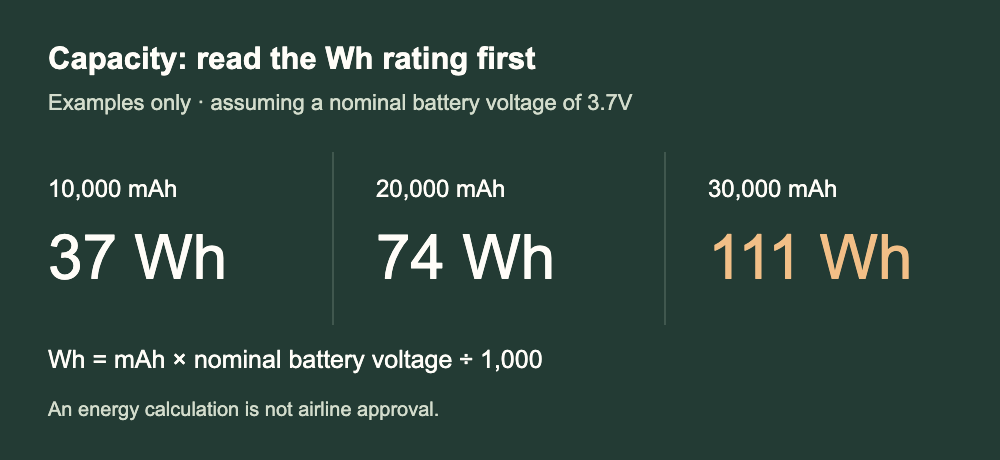
At 3.7V, a 20,000mAh bank works out to 74Wh. That calculation puts it below the 100Wh capacity threshold, but it does not answer the quantity, condition or onboard-use questions. Do not substitute a USB output voltage for the battery’s nominal voltage. If the specification is unclear, ask the manufacturer instead of guessing.
FAA: capacity calculations and battery packing guidance ↗
Keep it with you if your cabin bag is checked
The FAA requires power banks in carry-on baggage. If your cabin bag is taken at the gate or beside the aircraft to go in the hold, remove the bank first and keep it in the cabin. Protect its terminals from contact with metal and protect the battery from damage. If it overheats, expands, smokes or burns, alert the crew immediately.
Source: FAA PackSafe—Lithium Batteries. Several airlines above also prohibit overhead storage; use the location specified by your carrier.
Pack for the flight you actually booked
Before leaving home, check the airline shown as “operated by” on each flight segment. For a connection, repeat the check for the next carrier. Having one acceptable bank for both flights does not mean you can use it on both.
Charge your devices before departure, save your boarding pass and arrival details offline, and pack the cable and adaptor your airline says you need. That gives you a plan even when your power bank must stay disconnected.
Sources & image credits
Rules checked September 25, 2026 against Ryanair, Singapore Airlines and FAA PackSafe. The nine airline policies are linked beside their entries above. This guide compares published rules; it is not a product test or a universal airline policy.
Photography: Kaboompics.com / Pexels, used under the Pexels License. The photo illustrates ordinary charging, not permitted use on a particular flight. Diagrams: Next Up Guide.

