Amazon Prime
Big Deal Days 2026:
Know when to look.
Know what you save.
Find your sale window. Then check whether that big discount means a meaningful saving for you.
NEXT UP GUIDE · CHECKED SEPTEMBER 23, 2026
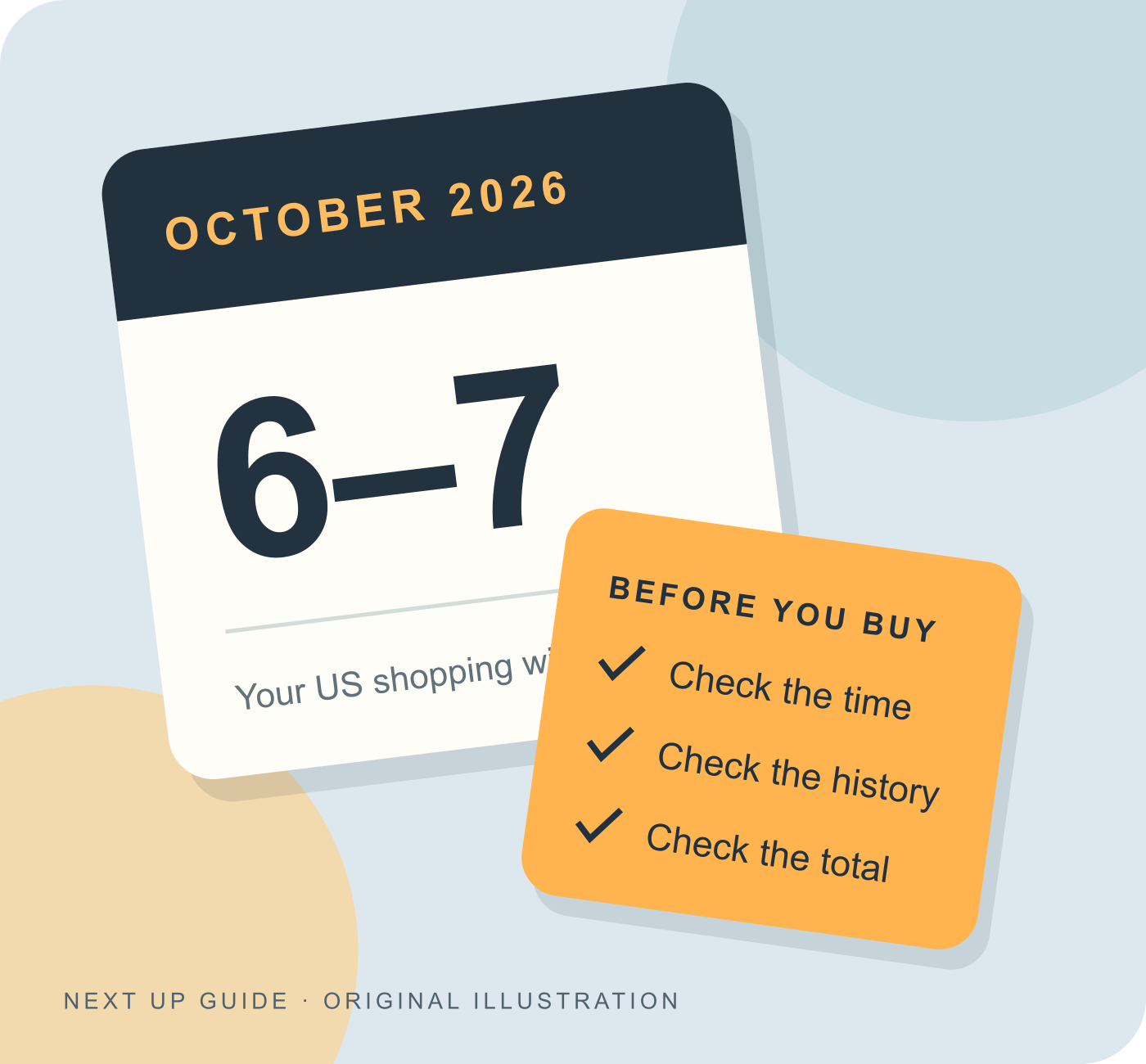
3:01 a.m. Eastern
2:59 a.m. Eastern on October 8
“40% off” sounds great.
What if you’re only saving $5?
That can happen when the reference price and the recent selling price are different. Here’s when to check Amazon’s sale—and how to compare the numbers before you buy.
Prime Big Deal Days is Amazon’s fall event for Prime members. This guide covers Amazon.com in the United States; dates can differ elsewhere. Amazon’s event FAQ.

Your sale window, in local time
| US time zone | Opens | Closes |
|---|---|---|
| Pacific · PDT | Oct 6 · 12:01 a.m. | Oct 7 · 11:59 p.m. |
| Mountain · MDT | Oct 6 · 1:01 a.m. | Oct 8 · 12:59 a.m. |
| Central · CDT | Oct 6 · 2:01 a.m. | Oct 8 · 1:59 a.m. |
| Eastern · EDT | Oct 6 · 3:01 a.m. | Oct 8 · 2:59 a.m. |
Pacific schedule: Amazon. Other zones calculated by Next Up Guide for these dates. Phoenix stays on MST and matches the Pacific times shown here.
On the East Coast? The event’s “October 6–7” dates use Pacific time, so the closing moment falls early on October 8 for you.
When are new deals added?
Amazon lists three daily release times for Today’s Big Deals:
1 a.m. Mountain · MDT
2 a.m. Central · CDT
3 a.m. Eastern · EDT
9 a.m. Mountain · MDT
10 a.m. Central · CDT
11 a.m. Eastern · EDT
2 p.m. Mountain · MDT
3 p.m. Central · CDT
4 p.m. Eastern · EDT
Source: Amazon’s 2026 announcement. Time conversions by Next Up Guide.
Amazon lists midnight for the recurring drops but 12:01 a.m. PDT for the event opening. Use 12:01 a.m. for the opening reminder. These are release times for Today’s Big Deals, not a promise that every product gets a new discount three times a day.
Our suggestion: pick a check-in that suits your day. Set a target price for your shortlist before browsing. A scheduled drop is a reason to look, not a reason to buy something you didn’t want.
Open Amazon’s sale page ↗Offers are subject to availability. The event page and individual listings show the current offers.
Two ways to read the same $60 deal
A percentage needs a reference point. Imagine a $100 reference price and a $60 sale price: that’s 40% off. But if the same item recently cost $65, the saving against that recent price is $5—about 7.7%.
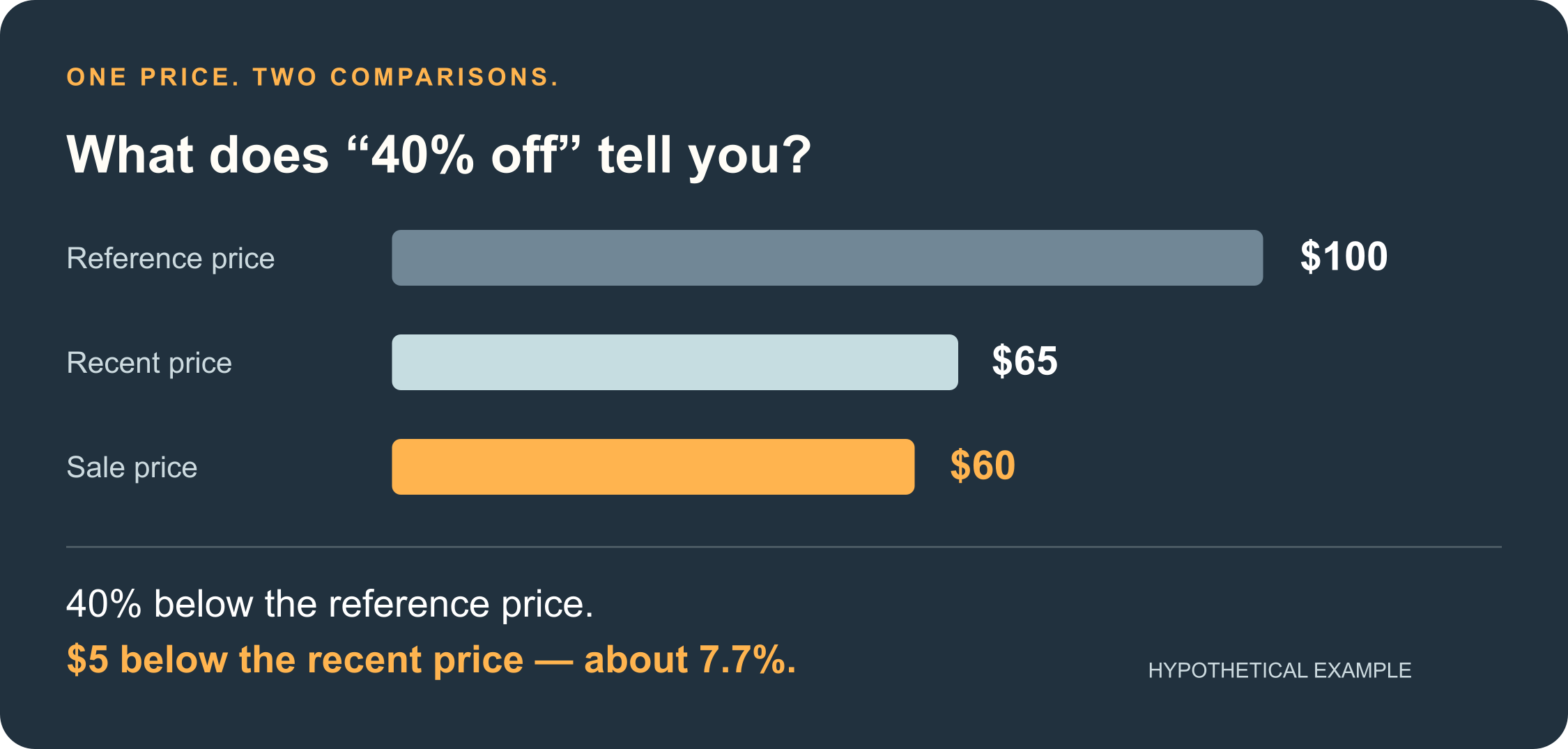
The $60 offer might still suit you. The useful question is whether it beats the recent price for the exact item you want.
Make it useful for your shortlist
What do your numbers say?
Use prices for the same model, quantity and condition. Here is the quick calculation:
Dollars saved = recent price − offer price
Percentage saved = dollars saved ÷ recent price × 100
With our example: $65 − $60 = $5 saved.
$5 ÷ $65 × 100 ≈ 7.7% below the recent price.
Use the reference price instead of the recent price to calculate the advertised discount. This comparison excludes tax, delivery, coupons and membership; compare your final totals separately.
Match the exact item first
Check the model number, size, capacity, pack quantity and condition. A refurbished item or a smaller pack needs its own comparison. Note the seller and included accessories, too.
Look at its price history
On an eligible Amazon product page, look for the price-history link beside the price. You can also ask Alexa for Shopping about the item’s recent prices. Amazon describes 30-, 90- and 365-day views, with the year-long view rolling out in the US.
If that view isn’t available to you, compare an identical listing at another retailer and any earlier price you recorded. Missing history does not establish that an offer is a record low.
Compare what you would actually pay
Compare final totals using the same delivery address. Include delivery charges, any coupon you qualify for and the cost of membership if you would join only for this purchase. A lower headline price may not produce a lower total.
Use your own buying threshold
Write down a price you’d be happy to pay before the sale. If the right model meets it and fits your budget, you have a reason to buy. If it doesn’t, you have a reason to close the tab.

Start with what
you actually want.
Right item → recent price → final total → your budget.
A large discount badge answers none of those questions on its own.
Will a later drop be cheaper?
The announced drop schedule does not establish future prices for your chosen item. Treat an offer you can see as a current option, not proof that waiting will help or hurt. Compare it with your target price rather than a prediction we cannot substantiate.
Do you need Prime?
Prime membership is required for the event’s member deals. If you’re considering a trial, check the eligibility and renewal terms shown to your account before enrolling. View Prime options ↗
Sources & how we made this guide
Checked September 23, 2026. Event facts come from Amazon; time conversions, the price example and shopping checklist are by Next Up Guide.
- Amazon: event dates, exact opening and closing times, membership
- Amazon: Today’s Big Deals release schedule
- Amazon: price-history feature and rollout
Independent guide; not affiliated with or endorsed by Amazon. No affiliate links. Both illustrations are original; neither is an Amazon interface screenshot. Stock photos by Mikhail Nilov and ArtHouse Studio are used under the Pexels license. They illustrate shopping in general, not this Amazon event.

