Can air-dry clay
get wet?
What sealing can—and can’t—do, before your next project becomes a vase, a dish or a garden ornament.
By Next Up Guide · Sources checked September 20, 2026
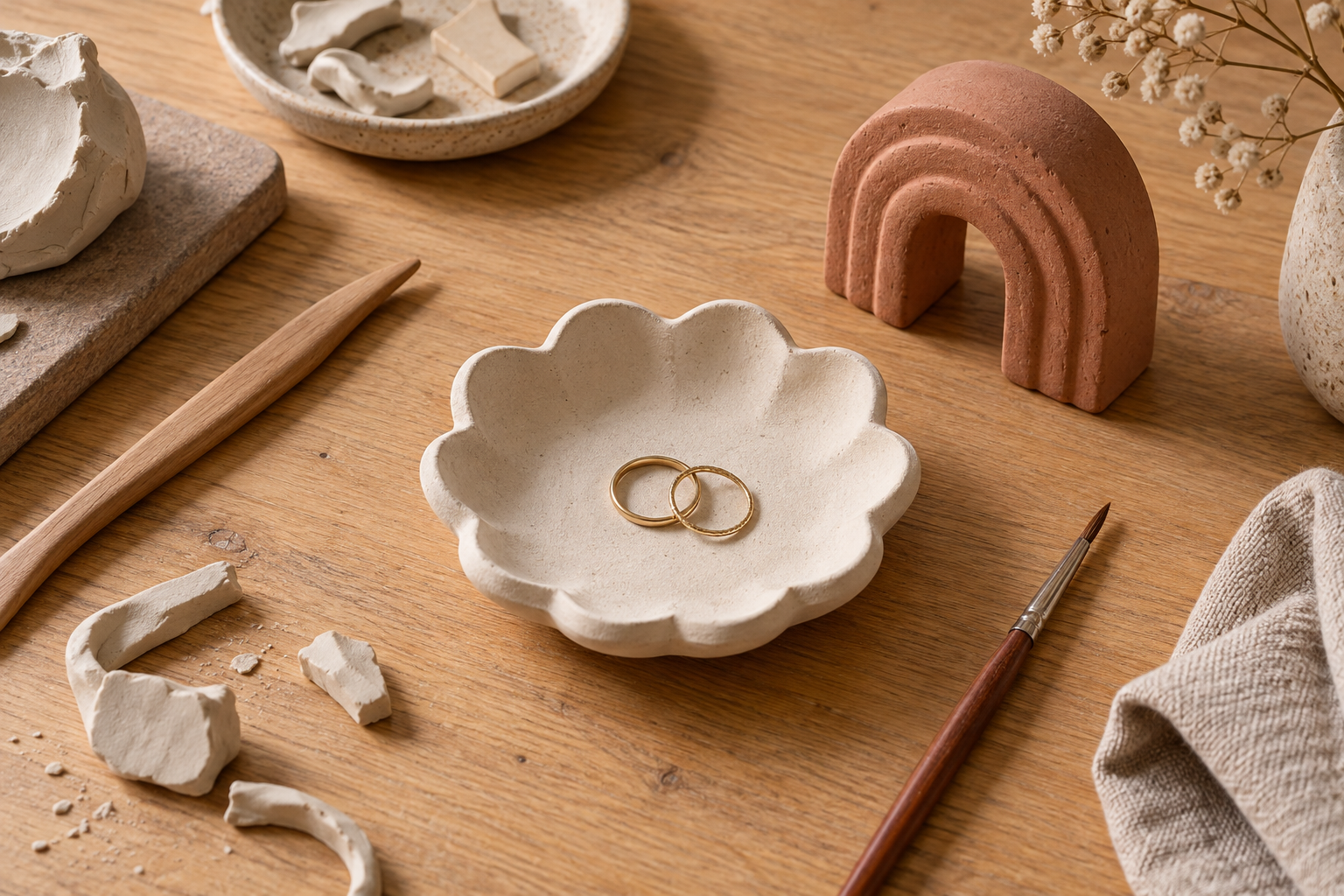
Don’t assume dried or sealed air-dry clay is waterproof. Crayola says its Air-Dry Clay remains vulnerable to water after sealing; Sculpey also says hardened air-dry clay is not waterproof. For these materials, plan around dry decorative use—not an object that needs to hold water. Manufacturer sources ↓
A glossy finish isn’t a green light.
A little handmade vase looks ready for flowers. The missing question is whether the material can live with the water inside it.
There are two separate decisions here: how you want the surface to look, and what the finished object needs to withstand. Choosing a shiny varnish answers the first. It does not automatically answer the second.
Sealed or water-resistant
Sculpey describes finishing as a way to improve durability and water resistance. The same guide still identifies hardened air-dry clay as non-waterproof. Treat those as different claims.
Not a waterproof conversion
Crayola explicitly says sealing does not waterproof its Air-Dry Clay. Its advice is to display finished pieces indoors.
Even “ceramic look” needs a careful read. FILA describes DAS VerniDAS as a protective varnish that gives a glazed-ceramic appearance. That product page does not establish that a finished DAS object can hold water or serve food.
Start with the job your piece will do.
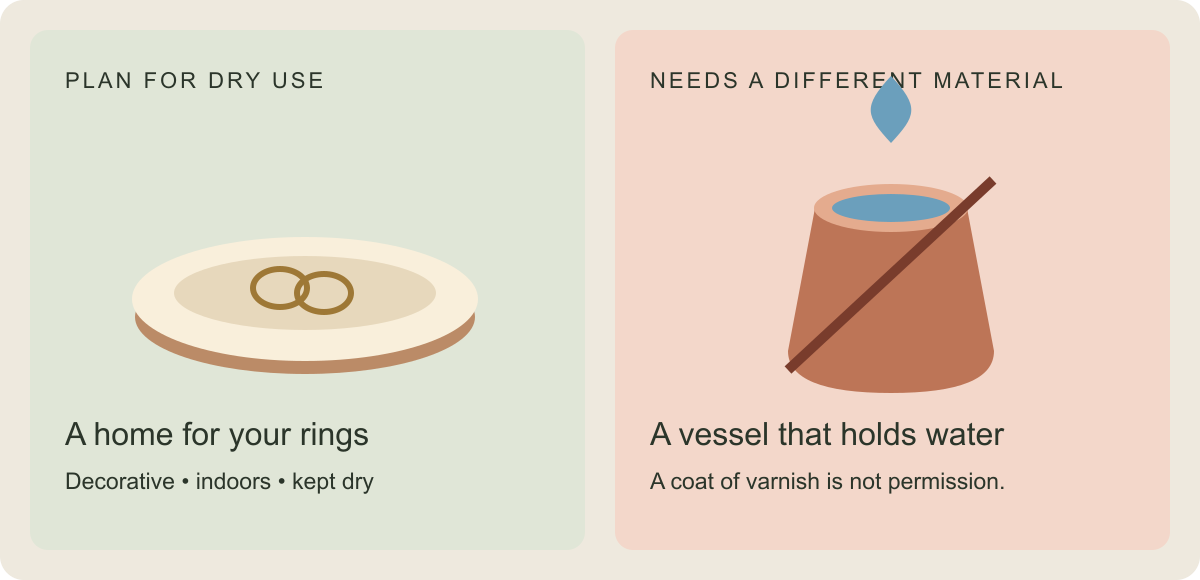
Trinket dishes & indoor ornaments
Think rings on a bedroom dresser, a sculpted arch on a shelf or a hanging decoration. We recommend these as dry-use project ideas. Sculpey specifically lists craft and jewelry projects among the uses for its Air-Dry clay.
Vases & plant pots
Crayola’s sculpting instructions exclude liquid contact. For flowers, choose a dry arrangement, as Mont Marte demonstrates, or a separate glass container, as in Sculpey’s jar-topper project. See both flower options below. Keep wet soil out of a clay-only pot.
Garden signs & outdoor decorations
For Sculpey Air-Dry clay, the manufacturer advises against outdoor projects because moisture and temperature changes can cause problems. Crayola likewise recommends indoor display, including for sealed pieces.
Mugs & snack bowls
Food contact is a separate issue from water resistance. Crayola’s instructions exclude food and liquid contact. Don’t turn a decorative dish into tableware just because the surface has been coated.
So, what should you make instead?
Keep the sculptural shapes, playful color and handmade texture. Give them a dry indoor job.
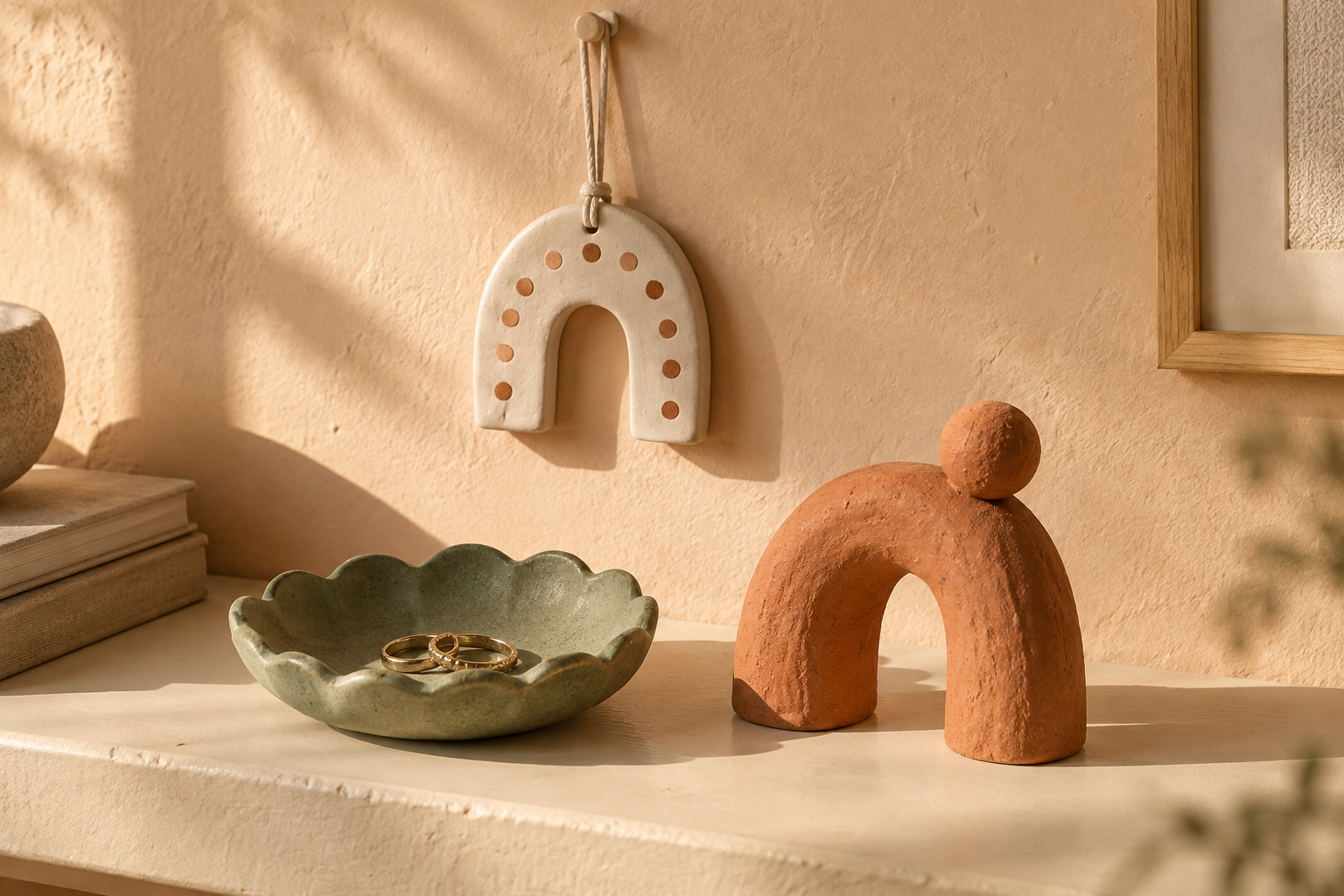
A personalized hanging decoration
A small wall piece gives you room to play with shapes, colors and a short message without needing a watertight vessel.
Sculpey’s Good Vibes Wall Hanging, designed by Amy Koranek, includes a paper-template method, cord and a tassel. The manufacturer provides the materials and illustrated steps.
Use the named clay: Sculpey Air-Dry. Follow that tutorial’s drying instructions.
See the official wall-hanging tutorial ↗A little home for jewelry
For a useful object that stays dry, a ring dish is a more straightforward brief than a soap dish or drinking cup.
Amy Koranek’s Porcelain Kitty Ring Dish tutorial for Sculpey shows how to shape a catch-all dish using a ceramic bowl as a form. It notes that drying takes several days in that form.
Different product: Sculpey Air-Dry Porcelain. This is not the same clay as the wall-hanging project.
See the official ring-dish tutorial ↗Both links include the manufacturer’s materials list and project instructions. Choose the tutorial that matches the clay you have.
“It doesn’t hold water” isn’t the whole test.
A coaster under a cold drink
Think about condensation and spills, not just whether you pour water into the clay. Our recommendation: choose a coaster made for moisture exposure and keep the clay project decorative.
A soap dish beside the sink
Wet soap, splashes and routine rinsing make this a wet-use object. Moving the same dish to a dry dresser for rings changes the job entirely.
Our recommendation follows the manufacturers’ moisture limits: Crayola’s moisture guidance ↗ · Sculpey’s Outdoor Use FAQ ↗
Check the clay first. Then the coating.
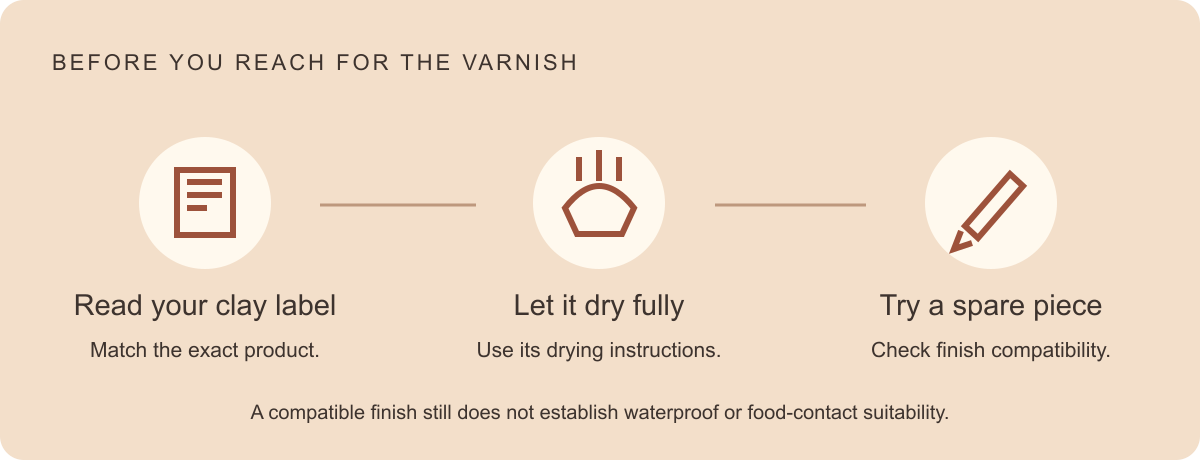
- Find the full product name.
Air-dry clay and oven-bake polymer clay are different materials. Advice for one is not automatically a recipe for the other. Sculpey sells both, so the brand name alone is not enough. - Allow the specified drying time.
For its Air-Dry Clay, Crayola specifies complete drying after 72 hours before sealing. That is product-specific guidance, not a universal timer for every clay or shape. - Test the finish before coating your favorite piece.
Crayola recommends an acrylic varnish and a compatibility test. Use a spare piece and follow the finish manufacturer’s application instructions.
Sources: Sculpey’s clay comparison; Crayola’s sealing FAQ.
Water, flowers and finishing.
Does air-dry clay dissolve in water?
It can soften and break down when exposed to water, even after hardening. Sculpey explains that air-dry clay is porous and susceptible to water-related softening and breakdown. “Dissolve” is less precise than that description: the practical problem is that the object can lose its integrity. Keep finished pieces out of soaking water.
Can I use it for dried flowers?
Yes—use a dry arrangement without adding water. Mont Marte’s official air-dry clay wall-vase tutorial finishes the project with dried flowers, grasses or herbs. It provides the shaping, drying and painting steps for that design.
For a concrete project to follow, use that wall-vase tutorial rather than adapting a water-filled vase design.
Source and tutorial: Mont Marte — air-dry clay flower vase ↗
Will extra coats make it waterproof?
No for Crayola Air-Dry Clay: its manufacturer says sealing does not waterproof it. Extra coats are not a manufacturer-backed way to turn that clay into a water-holding vessel. Use the varnish for the finish it is designed to provide, and use a separate glass container if your project needs to hold water.
Source: Crayola — sealing Air-Dry Clay ↗ · Glass-container example: Sculpey ↗
Can I follow a polymer-clay tutorial instead?
Not as a direct material swap. Oven-bake polymer clay needs heat to harden; air-dry clay hardens through drying. A polymer-clay tutorial’s baking temperature and timing therefore do not transfer to an air-dry product. For example, Crayola explicitly says not to put its modeling materials in an oven, microwave or kiln.
Borrow a shape or color idea, then use a tutorial and drying instructions written for your actual clay.
Source: Sculpey — how polymer clay hardens ↗ · Crayola — craft safety guide (PDF) ↗
Official sources
Checked September 20, 2026. Links below lead to manufacturer instructions and project tutorials. Product-specific guidance is identified by brand in the text.
- Mont Marte — air-dry clay flower vase for dried flowers
- Sculpey — Mason Jar Flower Holder, by Jennifer Courington
- Sculpey — common polymer clay questions
- Crayola — consumer craft safety guide (PDF)
- Sculpey — Good Vibes Wall Hanging, by Amy Koranek
- Sculpey — Porcelain Kitty Ring Dish, by Amy Koranek
- Crayola — sealing Air-Dry Clay
- Crayola — outdoor display
- Crayola — sculpting instructions (PDF)
- Sculpey — polymer clay and air-dry clay
- Sculpey — FAQ, Outdoor Use
- Sculpey — Air-Dry product page
- FILA — DAS VerniDAS
 Next Up Guide