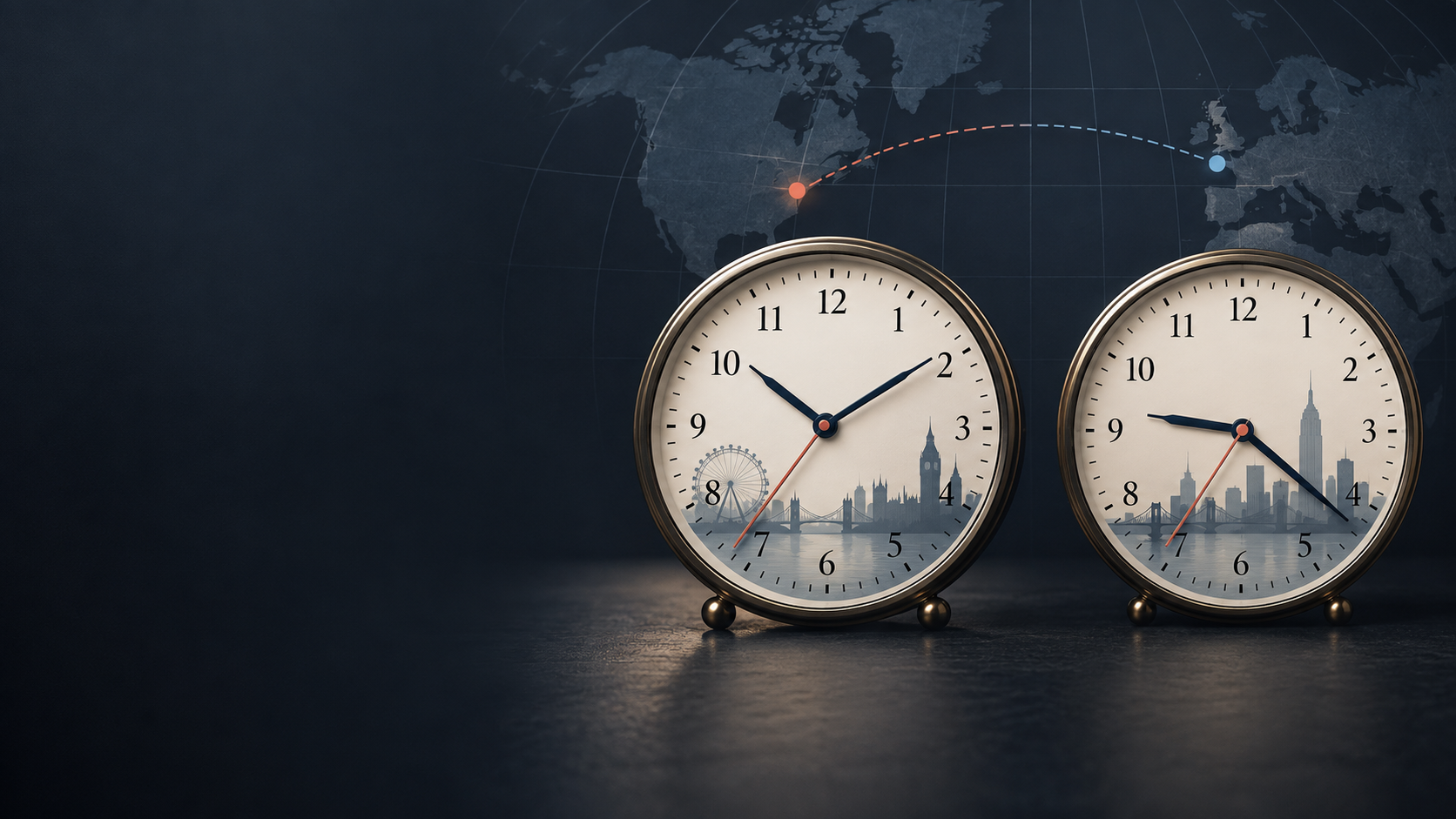
The UK puts its clocks back on Sunday, October 25, 2026. Most of the U.S. does it on Sunday, November 1. For daytime schedules from October 25 through October 31, London is four hours ahead of New York and seven hours ahead of Los Angeles—one hour less than usual.
Official dates: GOV.UK · U.S. National Institute of Standards and Technology
When do the clocks go back in 2026?
2:00 a.m. becomes 1:00 a.m.
At 2:00 a.m. British Summer Time, the clock returns to 1:00 a.m. Greenwich Mean Time. The 1 o’clock hour happens twice.
2:00 a.m. becomes 1:00 a.m.
At 2:00 a.m. local daylight time, the clock returns to 1:00 a.m. local standard time. The repeated hour happens in each participating time zone.
Earlier in 2026, the U.S. moved forward on March 8 and the UK on March 29. This guide focuses on the autumn change, when both move back and people receive a repeated hour overnight.
Wording note: the official U.S. term is “daylight saving time,” without an s after saving. In the UK, the summer period is called British Summer Time.
The week when the usual time difference is wrong
The UK returns to GMT first while New York remains on EDT and Los Angeles remains on PDT. That temporarily reduces both U.S.–UK gaps by one hour.
THE ONE-WEEK CLOCK GAP
9 a.m. New York
2 p.m. London
5-hour gap
9 a.m. New York
1 p.m. London
Only 4 hours
9 a.m. New York
2 p.m. London
5-hour gap
The exact gap begins when the UK changes at 2:00 a.m. BST on October 25. At that moment, it is still 9:00 p.m. EDT on October 24 in New York. It ends when New York changes at 2:00 a.m. EDT on November 1, which is 6:00 a.m. GMT in London.
Use the date, not a memorised time difference
This table keeps the U.S. starting time at 9:00 a.m. and shows what a London attendee sees. The middle row is the one most likely to catch a recurring meeting, livestream or phone call.
| Date | New York 9:00 a.m. | Los Angeles 9:00 a.m. |
|---|---|---|
| Friday, Oct 23 Before the UK change | London 2:00 p.m. 5-hour gap | London 5:00 p.m. 8-hour gap |
| Friday, Oct 30 Between the changes | London 1:00 p.m. 4-hour gap | London 4:00 p.m. 7-hour gap |
| Monday, Nov 2 After the U.S. change | London 2:00 p.m. 5-hour gap | London 5:00 p.m. 8-hour gap |
Those examples assume New York and Los Angeles are the event’s anchor cities. If a livestream advertises a fixed instant such as “17:00 UTC,” that UTC time does not change; only the local display changes.
Not every U.S. location changes its clock
The U.S. Department of Transportation says daylight saving time is not observed in Hawaii, American Samoa, Guam, the Northern Mariana Islands, Puerto Rico, the U.S. Virgin Islands and most of Arizona.
Arizona needs one extra check: most of the state stays on Mountain Standard Time, while the Navajo Nation observes daylight saving time. Do not apply a Phoenix conversion to every place in Arizona.
Sources: U.S. Department of Transportation · NIST’s Arizona note
What should change automatically—and what should you check?
- iPhone and iPad: go to Settings → General → Date & Time and make sure Set Time Automatically is on. Apple also recommends current software and internet access.
- Android: turn on both automatic date and time and automatic time zone. The exact path varies by device.
- Calendar invitations: create the event in a named city time zone and inspect an occurrence during October 25–31. Google Calendar and Outlook both convert invitations for each attendee’s local zone.
- Manual clocks: check watches, wall clocks, ovens, car dashboards, heating controls and other equipment that is not network-synchronised.
- Travel: use the local time printed in the latest airline or rail confirmation. Do not convert a departure time using last week’s U.S.–UK offset.
Device and calendar help: Apple · Android · Google Calendar · Outlook
Quick answers before the clocks change
Do I get an extra hour?
Yes, in places that move back. The 1:00 a.m. hour is repeated on the local change date. The UK receives that repeated hour on October 25; most of the U.S. receives it on November 1.
Will my phone alarm change by itself?
A current phone with automatic date, time and time-zone settings enabled should adjust. Check those settings before relying on an important alarm, particularly after travel or if automatic time has been disabled.
Is London always five hours ahead of New York?
No. Five hours is common, but it falls to four from the UK change on October 25 until the New York change on November 1. The countries also change on different dates in spring.
Does this guide cover all of Europe?
No. It covers the UK and U.S. rules. Do not use the UK date as a substitute for checking another country’s official rule.
The two checks that prevent most mistakes
Put October 25 and November 1 on the same calendar. Then open any recurring U.S.–UK meeting that falls between them and read the displayed local time instead of copying the previous week’s conversion.
Independent practical guide, checked September 26, 2026. Official government rules and platform support pages are linked above. Time conversions are Next Up Guide calculations based on those published transition times. Availability and interface wording can change by device version.

